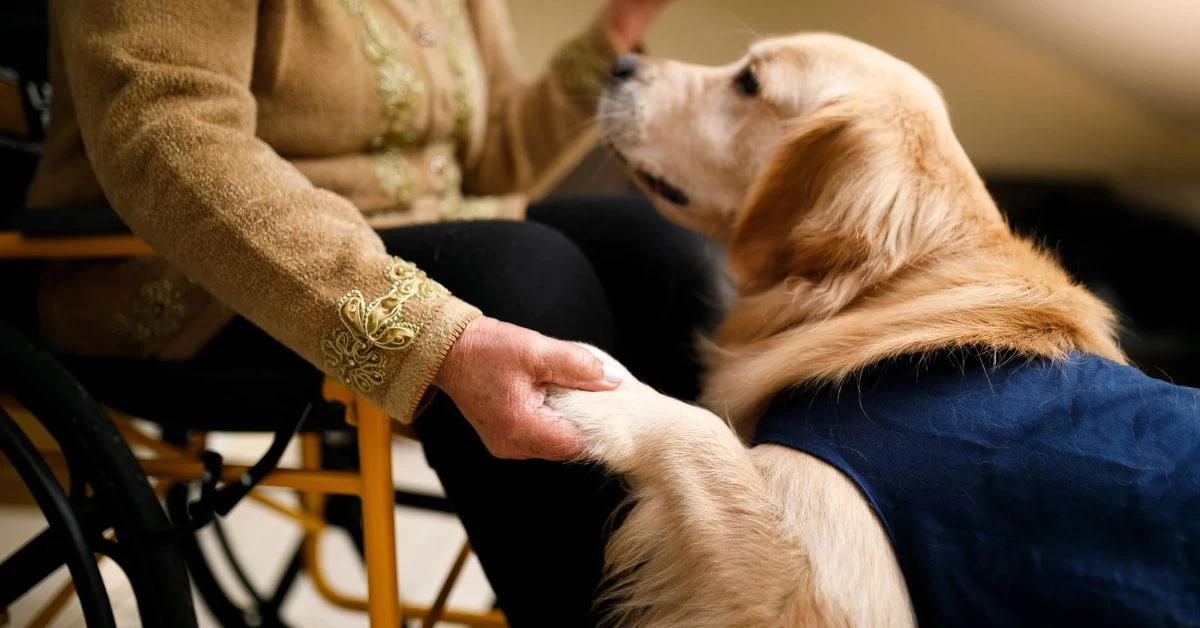
Doing your own shopping, travelling safely to work, picking up something you dropped or leaving the house with less anxiety. What is second nature to one person can be a daily challenge for someone with a disability.
A well-trained assistance dog can provide support with certain everyday tasks. Not only by carrying out practical tasks, but sometimes also by making more independence and confidence possible.
Yet getting an assistance dog is not as simple as buying a dog. There is an intake, suitable training, guidance for the combination of person and dog and, of course, the funding. An assistance dog can cost a lot, but you do not always have to bear those costs yourself.
In this article we explain which types of assistance dogs there are, what the training involves, when reimbursement is possible and how you can raise money yourself or together with others on Steunactie.
What is an assistance dog and what can it do for you?
An assistance dog is specially trained to support someone with a disability with concrete tasks in everyday life.
That can be something practical, such as opening a door, handing over an object or alerting someone to an important sound. A guide dog helps its owner get around safely. Other assistance dogs can learn to respond to certain signals and support their handler.
The training is tailored to what someone needs and what the dog can actually learn. So an assistance dog is not a general solution for every disability. Nor does it replace medical treatment, aids or professional support.
It also remains a dog that needs rest, exercise, care and regular training. A successful partnership has to be good for both the person and the animal.
What types of assistance dogs are there?
The term assistance dog covers different types of dogs. Their tasks, training and reimbursement options differ.
Guide dog
Helps someone who is blind or partially sighted to get around more safely, for example by avoiding obstacles and finding entrances or crossings. The person remains responsible for the route and the traffic.
Mobility assistance dog (ADL dog)
ADL stands for activities of daily living. This dog helps people with a physical disability with practical tasks, such as picking things up, opening a cupboard or handing over objects.
Signal dog or hearing dog
Trained for someone who is deaf or hard of hearing. The dog alerts its handler to sounds, such as a doorbell, alarm clock, alarm or a crying baby.
Autism assistance dog
Trained for supporting tasks that suit someone with autism, such as signalling sensory overload or supporting routines. What the dog can do differs per person and programme, and reimbursement differs per country.
Psychiatric assistance dog
Can be trained for tasks related to, for example, PTSD or other mental health conditions, such as responding to signs of stress. Not a replacement for treatment. A companion or emotional support dog is not automatically a trained assistance dog.
Epilepsy or diabetes assistance dog
Trained to respond to certain physical changes or signals. Possibilities and reliability differ per dog and situation. Such a dog does not replace medical monitoring, a glucose meter, alarm equipment or supervision.
How do you get an assistance dog?
The right route does not start with an advert for a dog, but with a conversation about what you need help with.
-
Map out what you need help with
Which everyday tasks are difficult? Which other aids or forms of support do you already use? And which specific tasks could an assistance dog carry out? A practitioner, occupational therapist, specialist or other professional involved can help clarify your support needs.
-
Contact a specialised assistance dog school
A training organisation assesses whether an assistance dog suits your situation. Often there is an intake, questions about your home situation and an assessment of the practical possibilities. Examples of Dutch organisations are KNGF Geleidehonden and Hulphond Nederland (both in Dutch). Which organisation is suitable depends on the type of dog and the programmes available.
Always ask how the training is organised, what experience the organisation has with your needs and how support after placement is arranged.
-
Choose between a trained dog and a programme with your own dog
Some organisations select, raise and train a dog before placing it with its future handler. There are also programmes in which someone trains a suitable dog of their own under professional guidance. Not every dog is suitable: health, character, ability to learn and behaviour in busy surroundings all matter.
Training an ordinary dog yourself does not automatically make it a recognised assistance dog. Have it assessed in advance whether the chosen programme meets the requirements that matter for reimbursement, quality and access.
-
Discuss the costs and funding before you start
Ask for a written quote and have it explained which parts are included. Also check whether you need to apply for approval in advance to qualify for reimbursement. That prevents you from starting an expensive programme for which there turns out to be no funding.
What does an assistance dog cost?
An assistance dog is expensive to train. There are many more costs involved than just buying a dog. Think of selection and upbringing, training of specific skills, guidance for the future user, exams, any aids and aftercare. On top of that, not every dog turns out to be suitable to complete the training.
KNGF Geleidehonden (in Dutch) puts the average at around €40,000 for the entire career of an assistance dog, from birth to retirement, including guidance and aftercare.
Please note
That is not the same as the price you pay yourself as a user. In some programmes, the training costs are largely or fully funded by a health insurer, an organisation or donations to the assistance dog school. In other programmes, for example for certain psychiatric assistance dogs, a large part of the training may be at the applicant's expense. The amount depends on the provider, the type of training and the guidance needed.
Don't forget the costs after the training
Even once the training has been paid for, costs remain:
- Food
- Vet
- Insurance
- Care
- Equipment
- Refresher training
- Later a replacement dog
So do not only ask what does an assistance dog cost?, but above all: which costs are covered, and which costs do I have to pay myself during the partnership?
Is an assistance dog reimbursed in the Netherlands?
That mainly depends on the type of assistance dog and your personal situation.
Reimbursement from health insurance possible
- Guide dog
- Mobility assistance dog (ADL dog)
- Signal dog
No regular reimbursement from health insurance
- Autism assistance dog
- PTSD or psychiatric assistance dog
- Epilepsy and diabetes assistance dog
Guide dog, mobility assistance dog and signal dog
In the Netherlands, these three types of assistance dogs can be reimbursed under certain conditions from the basic health insurance. You need a medical indication from the health insurer and a practical indication from the dog school. The health insurer can reimburse the purchase costs and contribute towards care.
So first check with your own health insurer which conditions and contracted providers apply, and whether you need approval in advance. You can find more information on the Dutch government's Regelhulp (in Dutch).
Autism, PTSD and other assistance dogs
For assistance dogs for, for example, autism, PTSD, epilepsy and diabetes, there is no regular reimbursement from health insurance in the Netherlands.
Sometimes the municipality can offer support as a tailored provision under the Social Support Act (Wmo). Municipalities are not obliged to do so, however. The municipality assesses your situation, the possible added value of the dog and other available solutions. So get good advice in advance and do not count on reimbursement until you have it in writing.
And how does reimbursement work in Belgium?
Belgium has different rules from the Netherlands. The routes also differ per region.
Flanders: support through the VAPH
In Flanders, you can apply for a contribution under certain conditions through the Flemish Agency for Persons with Disabilities (VAPH) (in Dutch). The VAPH assesses, among other things, whether an assistance dog adds enough value and whether other aids are not sufficient. An application requires a report from a multidisciplinary team.
To qualify for a contribution, the dog must also have a certificate from an authorised assistance dog school. In addition to the common types of assistance dogs, a contribution for an autism assistance dog may also be possible in Flanders. The VAPH gives no contribution for other dogs for people with a mental health condition. So always check the current VAPH conditions before you incur any costs.
Brussels and Wallonia
If you live in Brussels or Wallonia, support does not run through the same Flemish scheme. Ask the competent regional authority (AVIQ in Wallonia, the PHARE service in French-speaking Brussels), your health insurance fund or a social worker which route applies to your situation. Here too, it is wise to check the application and recognition conditions first and only then enter into any financial commitments.
What if the assistance dog is not or only partly reimbursed?
Then there are several ways to complete the funding.
- Ask the assistance dog school about funds and support. Some training organisations work with donors, funds or sponsors. Ask whether they offer their own funding scheme, work with funds or have advice on applying for support.
- Look into help from the municipality or social organisations. Depending on your situation, the municipality, a social worker or a foundation involved can think along with you. Not every organisation can pay for the training, but sometimes a contribution or a referral to a suitable scheme is possible.
- See which costs you can cover yourself. Perhaps you can save part of it, receive a contribution from family or have part of the programme paid by a fund. First map out what has already been arranged.
- Start crowdfunding for the remaining amount. Is there still a considerable amount left? Then crowdfunding on Steunactie can be a way to let family, friends, colleagues and others contribute together. Crowdfunding is no guarantee that you will raise the full amount, but you can share your story and ask others for help in a targeted way.
Is there still an amount left?
Put your fundraiser online and ask family, friends and colleagues to raise the shortfall for the training together.
Start a fundraiser for an assistance dogWhen is crowdfunding for an assistance dog a good idea?
A fundraiser works best when you know which programme you want to follow, what it costs and which amount is still missing. For example when:
- a psychiatric assistance dog is not reimbursed by basic health insurance;
- professional training of a suitable dog of your own has to be paid for;
- a fund or other scheme only covers part of the costs;
- family and friends want to help someone with a concrete funding gap;
- there are demonstrable additional costs that are not covered.
It is wise to first establish that a training organisation considers you, and possibly your dog, suitable for the programme. That way donors know the fundraiser is based on a concrete plan.
How to calculate the target amount of your fundraiser
Use the training organisation's quote as your starting point. The sample calculation below is fictional.
| Item | Sample amount |
|---|---|
| Training and guidance according to the quote | €20,000 |
| Own contribution | − €2,000 |
| Pledged contribution from a fund | − €4,000 |
| Still to be funded | €14,000 |
In this example, you want to raise €14,000 net. When setting your target amount, also allow for the platform and transaction fees of crowdfunding, so it is clear which amount will eventually be available.
On your fundraiser you can also explain what you will do with any extra proceeds. Think of agreed follow-up sessions or necessary costs during the programme. Only promise what you can actually deliver.
Starting a fundraiser for an assistance dog: how to go about it
-
Explain who needs help
You can start a fundraiser for yourself, your child, your partner or someone else close to you. Explain who is organising the fundraiser and what their relationship is to the person you are raising money for.
-
Explain which tasks the dog will carry out
Do not just write that an assistance dog is important. Describe clearly what the dog can help with in daily life, for example getting out and about more independently, carrying out practical tasks or responding to certain signals. You do not have to share a full medical history. Respect your own privacy or that of the person you are organising the fundraiser for.
-
Show that there is a concrete training programme
Say which organisation you are in touch with, whether an intake has taken place and what the expected programme involves. Share a rough budget if you like, without making private details or medical documents public.
-
Set a clear target amount
Explain which costs are already covered and what you need the donations for. Also state what happens if the full amount is not raised or the training unexpectedly does not go ahead.
-
Share the fundraiser with your network
Start with family, friends, colleagues, neighbours and people who know your situation. Ask them not only to donate, but also to share the fundraiser further. A personal message via WhatsApp, email or social media often works better than a general appeal alone.
-
Keep donors involved
Post updates when something changes: a successful intake, a new contribution, the start of the training or an important milestone. That way donors see what their support makes possible.
Sample texts for your fundraiser
Raising money for your own assistance dog
Help me towards more independence with an assistance dog
In daily life, I run into situations that others often take for granted. That is why I looked into whether a professionally trained assistance dog could support me.
Together with a specialised training organisation, I am working on a programme that matches what I need. The dog will be trained to help me with concrete everyday tasks.
Unfortunately, the costs of this programme are not fully reimbursed. After deducting the contributions already arranged, I still need €[amount] for the training and guidance.
That is why I started this fundraiser. With your contribution, you help me take a step closer to more independence. Sharing my fundraiser also means a lot. Thank you for your support!
Making an assistance dog possible for someone else
Together we're helping [name] get an assistance dog
For [name], certain everyday activities are a big challenge. A professionally trained assistance dog can offer support with [concrete tasks].
We are now in touch with [training organisation] and there is a plan for the training. The total costs are €[amount]. Part of it is already covered, but €[amount] is still needed. That is why we, as family, friends and others involved, want to raise money together.
Will you help make this programme possible? Every contribution helps, and sharing the fundraiser is greatly appreciated too. Many thanks on behalf of everyone involved.
Only use these sample texts if the intake, quote and other facts mentioned are actually true in your situation.
Practical tips to involve more people in your fundraiser
- Show what the target amount means. A concrete funding gap is easier to understand than a general request for money.
- Share a personal but careful story. You do not have to disclose all medical information to make clear why support matters.
- Use recognisable milestones. For example, let people know when the first phase of the training has been funded.
- Ask the people around you to help. Someone can donate, share the fundraiser, approach a local sponsor or organise a small benefit activity.
- Make agreements with the training organisation. Discuss when payments are due and what happens if the dog or the programme turns out not to be suitable after all.
- Stay honest about uncertainties. Waiting lists, training programmes and results are not fully predictable. A trustworthy fundraiser sets realistic expectations.
What does a fundraiser on Steunactie cost?
Creating and starting a fundraiser on Steunactie is free. You only pay fees when donations come in. For standard payments, Steunactie charges a 6% platform fee and €0.60 in transaction costs per donation, VAT included. Additional costs may apply for some payment methods. Donors are not asked for an extra tip for the platform.
Once your bank account has been verified, donations are paid out weekly as standard. Even if you do not reach your target amount, donations received are paid out according to the usual terms. See the current conditions on the rates page and in the frequently asked questions about payouts.
Frequently asked questions about assistance dogs and crowdfunding
Is a guide dog reimbursed?
In the Netherlands, a guide dog can be reimbursed under certain conditions from the basic health insurance. This requires, among other things, a suitable indication and approval. In Belgium, the schemes differ per region. Always ask the competent authority or training organisation about the options in advance.
Is an autism or PTSD assistance dog reimbursed?
In the Netherlands, these types of assistance dogs are not covered by the regular reimbursement of health insurance. A municipality can offer support under certain circumstances through the Wmo, but that is not guaranteed. In Flanders, a VAPH contribution may be possible for an autism assistance dog under certain conditions; for other psychiatric assistance dogs, the VAPH gives no contribution.
Can I have my own dog trained as an assistance dog?
Sometimes, through a specialised programme. A training organisation must assess whether your dog is suitable. Not every dog can learn these tasks safely and reliably. Also check in advance which recognition and possible reimbursement apply.
How long does it take to get an assistance dog?
That differs per type of dog, training organisation and availability. Selection, training and learning to work together can take a lot of time. Sometimes there is a waiting list as well. Ask the organisation you apply to for their current estimate.
Can someone else start a fundraiser for my assistance dog?
Yes. A relative, friend or colleague can organise a fundraiser together with you. Make clear agreements about where the proceeds go and discuss which personal information you want to make public.
What if the fundraiser does not reach its target?
Steunactie also pays out donations received when you do not reach your target. So decide in advance what you will do if the programme cannot start with the remaining funding, and state this on your fundraiser page. If refunding donors is an issue, check the applicable conditions in advance; that does not happen automatically because you miss your target.
Can crowdfunding money affect a benefit?
It can. Do you receive an income-related benefit or are you in a debt relief programme? Then discuss in advance with the organisation involved what donations mean for your situation. Tax rules on gifts may also be relevant.
Making an assistance dog possible together
An assistance dog can mean a great deal to someone with a disability. But the road towards it requires careful choices, time and sometimes a lot of money.
So first find out which assistance dog suits the support needs, choose a professional training organisation and check which reimbursements or other forms of support are possible.
Is there still a financial gap after that? Then you can raise money on Steunactie together with family, friends, colleagues and others for a concrete, well-founded training programme. Read more about crowdfunding for an assistance dog.
Ready to get started?
Start a free fundraiser on Steunactie and let the people around you help fund the assistance dog's training.
Start your fundraiser for an assistance dogCurrent fundraisers for an assistance dog


Help mij aan een PTSS-hulphond
Ik zou zo graag weer willen leven, in plaats van overleven. Help jij mij hierbij?


Van overleven naar leven 🩵
Leona (19) zameldr geld in voor een hulphond die helpt bij haar autisme en paniekaanvallen. Samen van overleven naar leven 🐾

We write about donating, crowdfunding and how donation platforms work, so you can make an informed choice about how and to whom you give.